
“We need people to be more strategic.”
I’m hearing this from leaders more often now, and it’s understandable. Gone are the days when they could bestow the year’s strategic plan on their teams. Instead, rapid changes in the terrain require you to rapidly revise your strategy for navigating it.
This is a lot of work! And executives simply can’t hold all the responsibility for all those decisions if the decisions need to be constantly revisited.
Instead, they want employees to think more strategically when working with clients. They want them to think ahead, ask better questions, and share insightful ideas.
But when pressed, leaders often struggle to articulate what being strategic means in practice.
Outside experts often make it worse. Ask a business advisor about how to get your team to be more strategic, and they focus on your strategic plan. Refresh your purpose statement, hone your mission, update the KPIs. You must need a planning day!
What leaders are usually trying to say is something simpler and harder at the same time:
Hey everyone! We all need to respond and adapt faster than we used to.
I can't hold all this alone. Help me figure out where the strategy is breaking and where we need to adjust.
They're not really asking for a single behavior change. They're asking for a stance: a way of thinking that helps people see how their decisions ripple through systems. Once people adopt that stance, they stop needing constant direction. They can make better calls on their own when conditions shift.
At its essence, "being strategic" is the ability to:
Plan several moves ahead
Anticipate changes in context and complex interactions
Accurately evaluate trade-offs
Make coherent choices at multiple levels, so the day-to-day actions lead to the desired outcomes over time
The call is for folks to adopt a strategic orientation.
Which makes simply telling people to “be strategic” a useless ask.
It's like asking people to be "quality oriented" or "safe" without highlighting what low-quality or unsafe practices look like.
In practice, we can think strategically about everything from where we want to be in five years to what we'll have for dinner in five days. When you have this great blurry range of strategic potential, how do you judge when your team answers the call?
We made this picture for a client to help them and their team translate the fuzzy “be strategic” into more concrete and relatable examples.
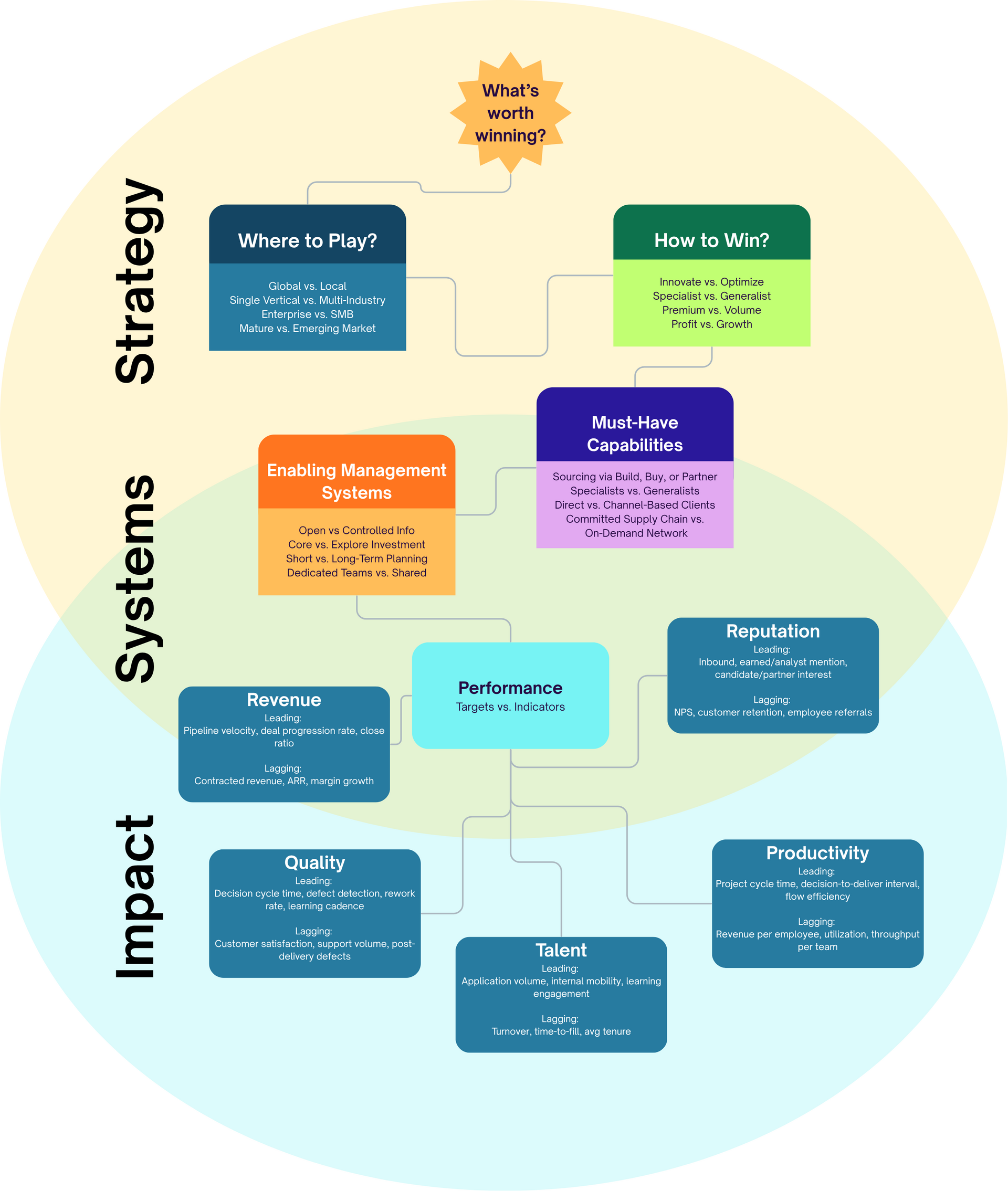
Strategic Tensions at Multiple Levels
There are hundreds of strategy frameworks, each with strengths and limitations. For this graphic, we're building on Roger Martin’s work because it describes strategy in plain language as a set of connected choices, each with inherent tensions. Zoom in and you’ll see common strategic alternatives in each box. It’s a representative set of examples, not a comprehensive breakdown of all the possible decisions.
The point is that rather than treating strategy as a single plan, we should be looking at how decisions interrelate:
What’s worth winning? suggests an answer to…
Where to play? which determines your constraints on…
How to win? showing you…
What capabilities and systems do you need to make those choices real?
What impact measures will help you evaluate if it’s working?
What tactics need to change based on how things play out?
Seen this way, strategy isn’t abstract. It’s not a special annual event or a fancy plan. Real strategic work is distributed and cumulative.
The more useful questions become: What level of strategic thinking do we need from each employee? How can we ensure better alingment across all strategic levels?
(To see other ways of breaking down strategy, I recommend this series by the Uncertainty Project.)
How We Use This with Groups (and You Can Too!)
We use this in:
Training: as a tool for ensuring teams have a shared way to think and talk about strategic thinking
Sensemaking: as a reference when evaluating strategic options
Finding Opportunities: as a way to clarify the context and unexplored potential behind requests
Examples below.
Conversation 1:
What is our strategy? What does being “strategic” mean for you?
Not everyone needs to think at the “Where to Play?” level. Not every decision warrants revisiting first principles. But everyone does need to understand how their decisions connect to larger outcomes.
You can refer to this picture when:
Explaining the strategic plan. Use it to talk through how the executive team is thinking about the higher-level tensions.
Clarifying where you expect individual initiative and judgment.
Aligning on where you need consistency vs where experimentation may be welcome.
Getting explicit about what “thinking ahead” looks like for each role.
These conversations can eliminate a lot of ambiguity and frustration.
Conversation 2: Is our strategy coherent today?
Every decision in this picture can be made in a thoughtful, forward-looking, “strategic” way. But that’s not enough. Reasonable decisions can also be wildly incompatible.
Consider how this happens.
“We need you to innovate faster and stay ahead of competitors!”
But… the approval processes are designed to catch mistakes. The performance metrics reward on-time delivery. And we promote people who execute flawlessly on the plan. So the team learns: stay in your lane, follow the process, don't surprise anyone. Innovation gets talked about in strategy meetings, but isn’t on anyone’s to-do list.
Each choice makes sense in isolation. Together, they create friction, confusion, and constant rework.
So for this conversation, use the picture to discuss vertical coherence. Questions to ask:
If this choice is true here, what needs to be true above and below it?
Where are we optimizing for a local function in ways that undermine other decisions?
Which choices were made under different assumptions, at different times, by different leaders?
Where are we operating on autopilot vs according to a well-considered choice?
What principles must guide us as we iterate these choices going forward?
When strategic choices can live together without constant translation and repair, work gets easier. When they can’t, no amount of clever planning or execution discipline will save you.
For more on this, I highly recommend following Roger Martin and his thoughts on Fixing Strategy.
Conversation 3: Thinking beyond the immediate request.
Beyond looking at your company's strategy, you can use this picture to improve how your team evaluates the work they're being asked to do.
Here's the exercise: When a task lands on your team's plate, trace backward:
What's the friction, complaint, or desired benefit behind this request?
What strategic choice or system gap is creating it?
Does that choice still make sense given where the company is now?
The payoff: You stop doing work that made sense six months ago but doesn't anymore. And you surface work that should be happening, but isn't because everyone's too busy with outdated tasks.
In other words, this helps teams work with an understanding of why the orders exist and when they should speak up if conditions change.
What else?
This picture makes the levels, trade-offs, and consequences of strategic thinking easier to see, so people can reason more clearly, argue more productively, and stop talking past one another.
If you’ve ever said—or heard—“we need to be more strategic,” this is a way to slow down and figure out what that means: strategic about what, at what level, and what does that look like for each person?
Now, what else might you use it for? What conversations do your teams need to have? I’d love to hear your ideas.